
choice — pick one, and show the odds on all of them
Returns your chosen option plus a probability on every option you offered, and a confidence you can threshold on.
Language in, types out · Jev AI decisions on sign-up · No card
Paste a state. Name the questions you branch on. Jev AI hands back the answer, the probability behind every option, and the code that produced it.
choice · score · noul · calibrated probabilities · no card
See what a plan unlocks →New to typed decisions? This is one real run on this page: paste a state, name the questions, press Run, read the odds, copy the request.
ONE MEASURED CALL
These are our own numbers off a live request on 2026-09-21 — a support ticket and three typed questions in one call. Not a figure off a launch post.
End to end
request sent to answer parsed
Billed
for the whole call
Input tokens
state plus all three questions
Output tokens
output is never billed
The routing step. The moderation step. The is-there-anything-of-concern step. None of those need a model that writes prose — they need one that picks. Move them to Jev AI and the rest of your pipeline stops waiting on them.
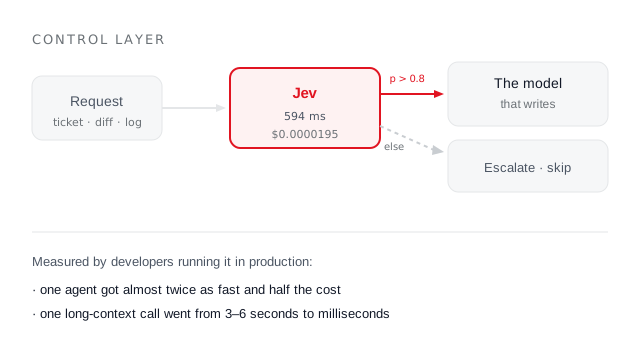
Decide which tool, which agent, which branch — then spend the big model's budget only on the request that earned it.
Run a routing decision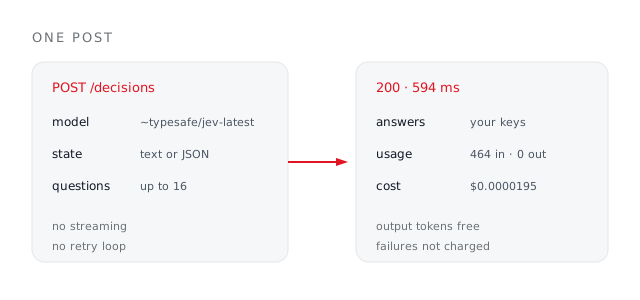
Ask whether there is anything of concern in the transcript, the diff, the ticket queue. Pass on only what comes back positive.
Run a triage decision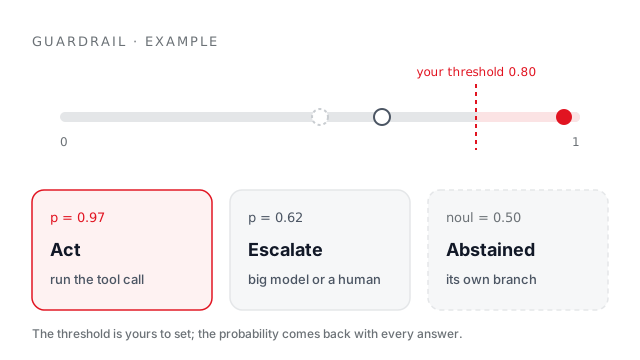
Every answer ships with a probability and a confidence. Act above your threshold, escalate below it, and let a noul of 0.5 be its own branch.
See the API shapeThis is a real Jev AI response, not a mock: the option it picked, the odds it gave every option you offered, and the confidence behind the pick — returned in under a second.
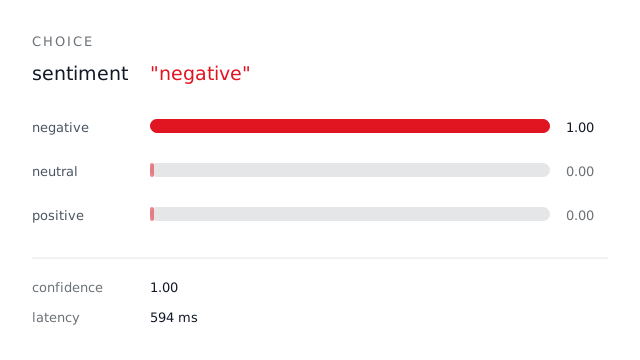
A bare label is what every model already gives you. What makes this worth wiring in is the probability beside it: route confidently above your threshold, escalate below it, and let the gap between first and second place tell you when your options do not fit.
Run one on your own textEach Jev AI question declares which shape it wants, and each returns something structurally different — which is what makes the answers safe to branch on.
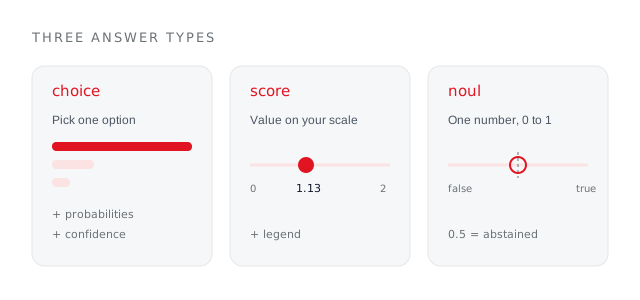
score lands on the scale you defined and nowhere else. noul returns one number, and at exactly 0.5 it is telling you it declined — give that its own branch rather than rounding it away.
See all three explainedJev AI takes language in and returns types out. You send a state — a ticket, a diff, a JSON payload, a transcript — plus the questions you want answered and the criteria for each. What comes back is JSON your code can branch on: the option it picked, the odds it gave every option, and a confidence. There is no paragraph to parse and no schema to coax out of it.
Returns your chosen option plus a probability on every option you offered, and a confidence you can threshold on.
Returns a continuous value between your endpoints and echoes the scale back as a legend, with the probability mass on each step.
Comes back between 0 and 1, and 0.5 means the model declined to take a side. That is a third branch, not a coin flip.
No retry loop to force the shape. The response keys match the question names you sent, so reading it is a property access.
Every one of these came out of developers describing their own builds in public over the past two weeks — not a list of things the model could theoretically do.
Swapping the routing and tool-selection steps out of the LLM made one developer's agent almost twice as fast and half the cost.
r/LLMDevsOne team asks Jev first whether there is anything of concern, before the expensive model reads the context. That call went from 3–6 seconds to milliseconds.
r/singularityCoding agents deciding on the spot whether a command is safe to auto-run, without a round trip to a model that writes.
r/PiCodingAgentOne engineer who used to build decision trees for credit scoring calls this strictly better and far easier to run.
r/ArtificialInteligenceSuccess rolls in text RPGs, and bots taking their own turns in Slay the Spire 2 and Doom — decisions cheap enough to make ten a second.
r/LocalLLaMATicket triage, content moderation and intent detection, where the answer was always a label and never a paragraph.
r/LLMDevsOur own request on 2026-09-21, read straight out of the usage field the router returned.
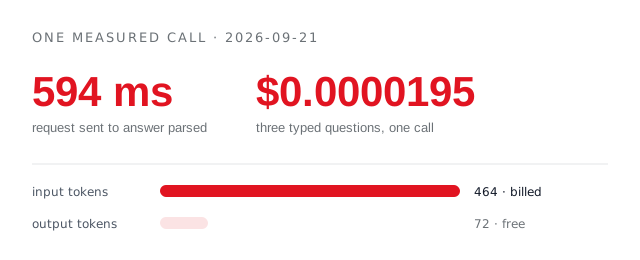
A short support ticket with three typed questions came to 464 input tokens. You pay for the state and the criteria you send; the answer, the probabilities and the confidence come back at no charge — which is why asking four questions in one request is the cheap way to ask.
See plansFour steps from a blank box to a typed answer and the code behind it: paste the state, name the questions, pick each answer type, run.
Any text or JSON — a ticket, a diff, a transcript, a payload.
One name per thing you branch on, and what each answer means.
choice to pick, score to rate on your scale, noul for a single number.
Read the probabilities, then copy the exact request that produced them.
The call
A real request and the response it produced. Nothing here is a mock — the numbers in the answer are the ones the router billed.
{
  "model": "~typesafe/jev-latest",
  "state": "My order arrived three days late
            and the box was crushed.",
  "questions": {
    "sentiment": {
      "type": "choice",
      "instructions": "Overall sentiment.",
      "criteria": {
        "positive": "Happy or satisfied.",
        "neutral":  "Neither.",
        "negative": "Unhappy or angry."
      }
    }
  }
}{
"model": "typesafe/jev-1.13-20260917",
"answers": {
"sentiment": {
"type": "choice",
"choice": "negative",
"probabilities": {
"positive": 0,
"neutral": 0,
"negative": 1
},
"confidence": 1
}
},
"usage": { "input_tokens": 336, "output_tokens": 39, "cost": 1.4112e-5 }
}Add up to four questions and they share this same state, this same round trip, and this same 10 credits.
The questions developers are actually asking about Jev AI, answered.
Jev AI is a decision model: it takes language in and returns typed values out. You give it a state and the questions you branch on, and it returns the option it picked, a probability on every option, and a confidence. It is used wherever the answer was always going to be a label, a rating or a yes — routing, moderation, triage, scoring — and never a paragraph.
It is BERT-shaped in what it returns and nothing like BERT in what it takes to use. This one is zero-shot: the criteria live in the request, so you point it at a new label set without a dataset, a fine-tune or a redeploy — at LLM-level understanding of the text, in under a second.
No. It takes language inputs, just not language outputs. Every answer is a typed value with the numbers behind it, which is exactly why there is no schema to coax out of it and no retry loop to make the shape stick.
It is a zero-shot one, and that is the whole difference. A classifier you have to train for every label set is a project; one that reads your criteria out of the request is a function call. Same output shape, nothing to build first.
Yes. A new account starts with 2 free decisions and no card, and the daily check-in adds 11 more across a seven-day cycle. It is enough to point Jev AI at your own text, read the probabilities and copy the request before you decide anything.
TypeSafe AI is the company that built and hosts the Jev model. Jevx is an independent tool on top of the Jev API — not affiliated with TypeSafe AI, and not their official site.
Paste a state, name the questions, press run. The answer comes back with the odds on every option and the exact request that produced it. Two on the house when you sign up, no card, and a failed request costs nothing.